
Panic! At the Primary Care Appointment
The doctor seemed uncomfortable around the human body, as doctors often do.

Welcome to Uneasy Going! If you’re new, thank you for being here! If you’ve been with me for a while, thank you for not unsubscribing! If you liked this post, press the heart button so it can reach more people. If you don’t like it I encourage you to heart it anyway, out of pity.
I recorded an audio version above, in case you want to listen to this in the waiting room of a doctor’s office.
I went to a new primary care doctor last week. I found her online by searching for available doctors at the large San Francisco hospital where I see my psychiatrist. She had a handful of admirable Google reviews. She possessed all of the qualities I look for in a doctor: a woman who accepts my insurance and has immediate availability.
My partner has a passion for medical appointments that I have only before seen in people who are parents. The night before, he sat me down and together we made a list of everything I should ask during my 16 or so minutes with the doctor. I am—to use a phrase I learned in a college seminar about gender and sexuality and do find helpfully perception-shifting—a temporarily able-bodied person. As a result this list was very short, and sure to bore anyone who has lasted long enough in medicine to become a working doctor. It went like this:
Check iron levels?
Headaches sometimes
Acid reflux still: why?? Ask for prescription?
Lately I have been thinking about going off the SSRIs I take for anxiety. I thought about asking the doctor her opinion, though I thought she would probably just say, “That’s something to talk about with your psychiatrist.”
When I arrived in the office I was greeted by a man sitting behind the desk. He smiled and fixed me with the kind of eye contact that would prompt an introvert to excuse themselves for the purpose of standing alone in a bathroom, staring at the wall.
“Welcome,” he said. “I’m so glad you’re here. You have picked the best practice.”
He had an intentional way of speaking—slow, each word deliberate. And then there was that eye contact, which was less suggestive of a receptionist and more of the leader of a wilderness rescue team making first contact with a child who has been trapped for three days.
A woman sat behind the desk, next to the man. She was on the phone, but she still looked over and grinned in welcome.
The man explained that I was there for a physical, and that I was entitled to one physical annually. I agreed that this was the case. He said, in his measured, friendly way, that during a physical, the patient may ask certain questions pertaining to their vitals and their medical history. If the patient asks other questions, they may face additional charges. The patient may be charged for asking questions about any part of their body that is in pain. They may be charged for asking about new symptoms, or existing symptoms. They may be charged for asking about chronic conditions.
I have been to many primary care appointments, but I could not remember any other one that was so à la carte. He handed me a piece of paper that explained everything he was saying and required me to sign, acknowledging that I understood that I would be billed for asking questions about these issues, plus a few others.
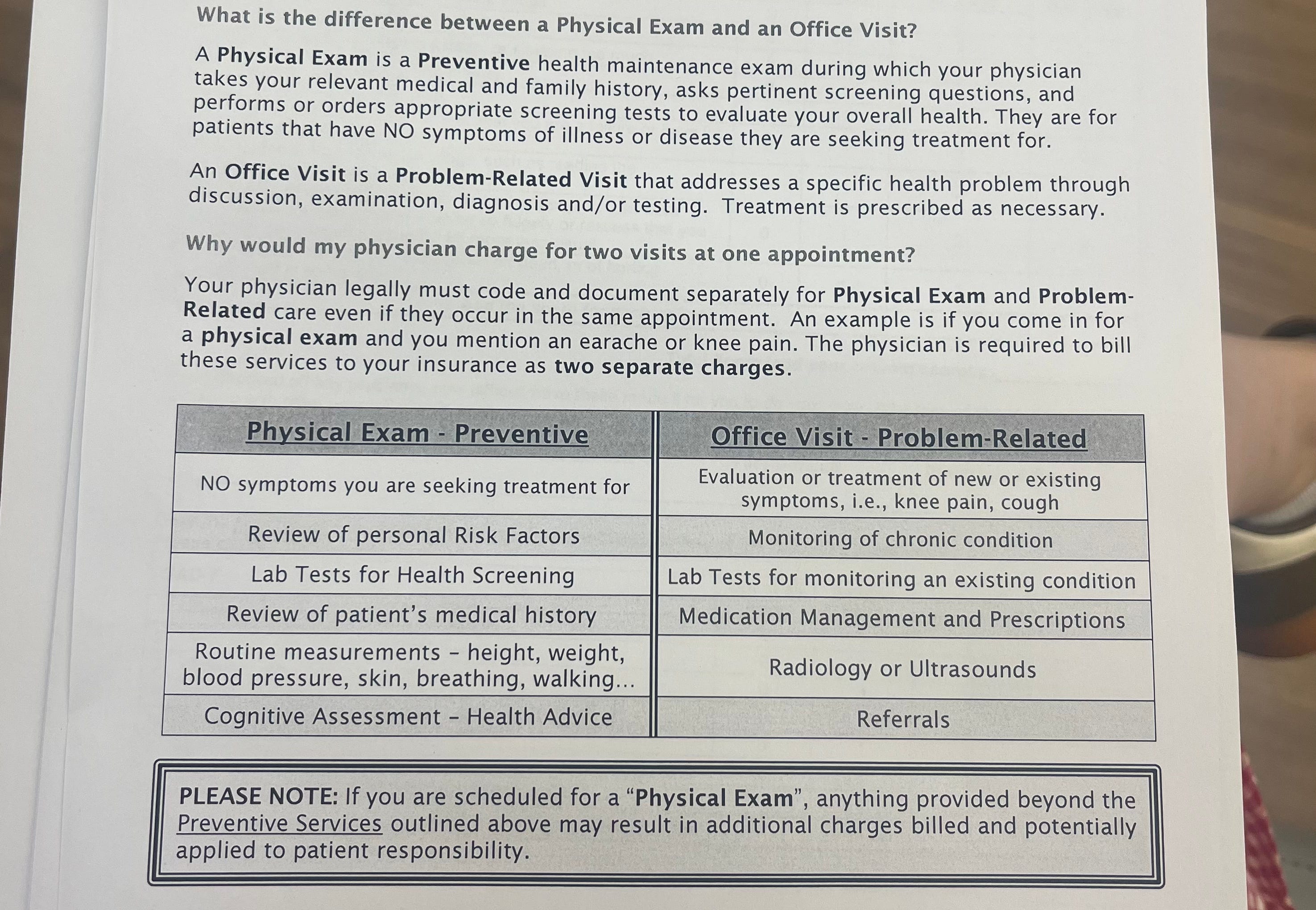
“Say you hurt your elbow,” the man behind the desk said, pleasantly. “And you tell the doctor, ‘My elbow hurts.’ That is something you would be charged for.”
“So,” I said. “You are telling me that I can’t ask the doctor about…physical pain?” I made sure to say this as meanly as possible. The man smiled a world-weary smile.
“We have people come in for physicals, and then they get bills in the mail and they call us and say, ‘WHAT IS THIS BILL FOR?’ And we have to tell them: ‘Well, you asked about your elbow.’ The thing is, they are getting billed because the doctor has to code their question differently, because it’s not covered by the physical.”
“Okaaaaay,” I said, regressing with ease to my former self (a cruel teenager.) “If I tell you what I want to ask the doctor about, will you tell me how it will be ‘coded’?”
He said that the medical assistant who would check me in would probably be able to tell me. He leaned in and said, more quietly, “If you have really bad insurance, like if your copays are really high, I do recommend just asking about other issues now, to avoid coming back and getting charged for more appointments.”
“I just feel like this has never come up at any previous physical appointment,” I said. The man continued to smile.
“This has been true at every physical appointment you have ever had,” he said, gently. “We’re just telling you about it.”
The woman next to him hung up the phone and leaned towards us.
“A weeping rash!” she exclaimed. “I was on the phone before so I didn’t get to say this, but my example of something you can’t ask about in a physical is a weeping rash!”
“Okaaaay,” I said, summoning the bitchiness of a thousand covert bullies who are regarded by teachers and parents as having untapped leadership qualities. “I won’t ask about a ‘weeping rash’ at this doctor’s appointment.”
“It’s because of insurance companies,” the man said.
I had known the whole time that it was because of insurance, but I guess I had been pretending to myself that it was the office worker making these decisions, instead of my insurance company, which took in, at last count, $863 million a year in revenue.
I sat down in a flurry of self-dislike and began to fill out a sheaf of papers. The papers included a list of diagnostic questions about anxiety disorder. It is a form I have filled out dozens of times. I noticed with surprise that my anxiety level, at least on paper, was very low.
The woman behind the desk continued to make phone calls. Like the conversation we had just had, these were unlike my previous experiences in doctors offices, and so unusual that it sounds exaggerated.
“Hey girl!” she trilled. “I am lovin’ this WHETHA! Anyway, just calling to remind you that you have an appointment in our office tomorrow at 3pm.”
As I told the form that I belong to a religious organization and frequently call my friends and family, she told a patient, “Coolio. I will talk to you soon. See ya.”
I was called into the doctor’s office. I quizzed the medical technician on whether my questions would be covered by insurance. She said yes to the iron check and the headaches, but she wasn’t confident about acid reflux. I realized that I would just have to ask rather than make a second trip and a second copay to ask.
She took my vitals. My resting heart rate typically scrambles into the 90s during doctor’s appointments. A medical assistant once told me that when your heart rate spikes in the doctor’s office, this is called “white coat syndrome.” I don’t have health anxiety. I am never worried that the doctor is going to give me a death sentence. It’s more like the social anxiety of being at a two person party where you are almost naked and your conversational partner is determined to find out what is wrong with you.
I peered at the machine. My heart rate was 77. I haven’t had such a low heart rate at a doctor’s appointment in years.
The doctor came in. She seemed bored and uncomfortable around the human body, as doctors often do. She had a vocal style that led her to sound slightly disgusted.
“Do you…get your period?” she said, sounding like a divorced dad talking to his tween daughter.
She came alive when I asked about acid reflux, offering me thoughtful explanations and prescribing a course of proton pump inhibitors. I got dressed and went back into the reception area.
“I am lookin CA-YUTE today!” I heard the woman behind the desk say to nobody.
It seemed possible that my heart rate was so low because the front desk workers in the doctor’s office had been obscurely friendly. It could also be that my anxiety medication was working, or that I have achieved a lifestyle with few stressors, or that exercise was finally paying dividends, or that the machine was broken.
The doctor certainly couldn’t tell me. The psychiatrist wouldn’t be able to tell me, either. We could all only guess. It was a pleasant change, at least. I walked into the bright sun and went home to wait for my surprise bill.
The exchange with the people at the desk should be sketch comedy, but that’s our healthcare/insurance system at work.
Hi Jenny! I saw this article in the Washington Post; for your reading pleasure: https://wapo.st/4efXjqk