
Adventures With a Theragun
Can tech-y gadgets help reduce anxiety?

Thanks for reading Uneasy Going! You can listen to a non-AI version of this essay below, while trying out your Theragun. Please <3 this essay to help me reach more readers/Theragun users.
“You cannot take a tranquilizer to recover from making your wedding invitations,” I told myself. I tried to be firm, like a young parent setting boundaries with a wayward child. “You cannot do that. You cannot take a beta blocker to deal with Zola.”
I will say, defensively, that I did not feel anxious about my wedding invitations. It is true that creating them demanded a surgeon’s finesse and a graphic designer’s knowledge of typesetting. They were not anxiety-provoking, though—instead, the experience made me feel physically tense. After three hours of experimenting with serifs and sans them, with line height and letter spacing, I was in minor pain. My neck hurt from straining to put ampersands in the right place. My muscles felt tight, as if I had been parallel parking a cruise ship, instead of moving the words “We can’t wait to celebrate with you!” millimeters up and down a digital interface.
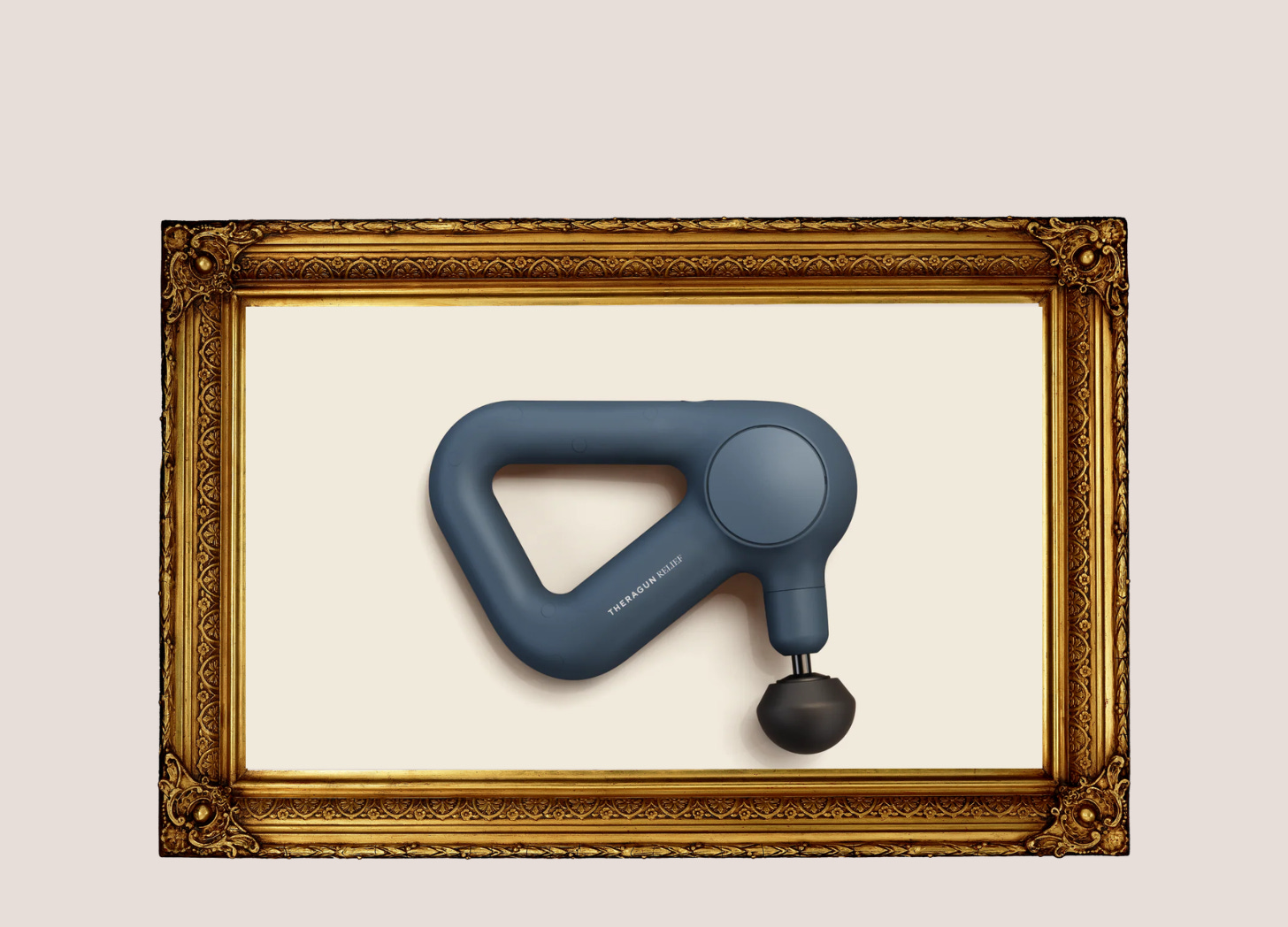
Since I was not willing to face the idea of medicating myself over wedding stationary, I tried to administer manual relaxation by violently rolling my neck and doing that kind of cross-body arm stretch that people do on TV shows before they play recreational baseball. Observing this, my partner bounded to the closet, and returned with a piece of gleaming white plastic with a tennis ball-sized foam attachment on the end: a Theragun.
I turned on the Theragun and ran it along my shoulders and my neck. It was forceful in a way that is uncommon in an at-home gadget. It made me feel unusually aware of every one of my teeth. I reached over and let it drill my shoulder muscles. It was much more effective at reducing the feeling of tightness than my usual method, which is to give myself a hard pinch in the muscles between my neck and my shoulders. I tried running it along the base of my skull, which felt like getting lightly punched. The motor seemed strong enough to cause injury.
A Theragun is a sleek, expensive, and high-powered vibrating massage gun. Theraguns seem like sex toys but they are not, unless your kink is going to the hospital with a genital injury. They are made by a company called Therabody, created by a chiropractor named Jason Wersland. According to his telling, he developed the Theragun while recovering from a painful motorcycle injury. It was frustrating, he said, that opportunities for relief were limited by his access to other chiropractors’ services.
“It hit me: I’m dependent on someone else’s time to treat me,” Werslund said in an interview earlier this year. “I knew exactly what I needed—warmth, a massage, something to soothe the muscle. But I’d have to wait for someone else to give it to me, and that didn’t make sense.”
This thought process is relatable to anyone with anxiety, or any other chronic condition—you might get great relief from costly services like going to a spa, or hiring a masseuse, or somatic therapist. But it’s frustrating to feel tethered to another person’s skillset, calendar, and billing system. The promise of a device, which costs less than a single session with a clinician and can deliver years of relief with the click of a button, is appealing. The downside is that this promise too often leads to having one more piece of useless plastic in your home.
The Theragun chipped away at my muscle tension. I zoomed it around my body like I was pretending to be a race track for a Hot Wheel to entertain a child. After using it, I felt better. The catch was that I felt only a little better. I still felt tense. But it was nice to have done something that clearly diminished the symptoms of my anxiety disorder, even just a little.
“Anxiety causes muscle pain” feels a little made up to me, even as I experience it. “When the body is stressed, muscles tense up,” the American Psychological Association explains. “Chronic stress causes the muscles in the body to be in a more or less constant state of guardedness.” Muscle tension is listed in the DSM-V as an anxiety disorder symptom (it must be “present for more days than not for the past 6 months” and appear in coordination with other symptoms.)
Unlike the vibrating, warming, massage vest that I once bought from Amazon (discarded after a year,) or my headache block (trusted, used regularly,) or my vibrating face washing tool (discarded after a few uses, possibly damaging,) my possession of the Theragun is not the result of brimming with hope and belief while holding a credit card. My partner received the Theragun as a work perk several years ago from his then employer. It was an oddly intimate gift. I imagine it was intended to convey something like: “We like you more than a hundred dollars worth, and we hope you will find a way to relax on your own time and return to your keyboards with loose muscles and a renewed zeal for work.”
I remember Theraguns being extremely popular, but I thought their time had come and gone. I thought that a Theragun was like a Peloton—a piece of premium wellness technology that enjoyed a craze around 2020 and then petered out after exhausting its entire customer base. Once you have one you don’t need another one, and you might even use the one you have.
But that’s not what happened. Instead, Therabody—the Theragun company—expanded. They made mini, pro, and heated versions of the Theragun. They made Therabody cupping devices, and a number of fitness wearable products, including a pair of vibrating, crotch-high boots that are $1,100 and are aimed at athletes. In 2021 a cadre of celebrities that included Rihanna and Justin Timberlake invested in the company. Therabody expanded into skincare, making a line of gadgets that includes red light masks and anti-puffing wands. WireCutter devoted an entire feature to Therabody just last month.
Theraguns are pounding away at as many demographics as they can manage. You can buy a Therabody product on Revolve, a website known mostly for selling dresses that are a little too expensive for what they are, and you can also pick one up at a Target or Sam’s Club. Whenever I walk into The Shops at Columbus Circle, a huge, glassed-in mall on the corner of Central Park, I fantasize that I am going to have a profoundly glamorous shopping experience. But that’s not what happens. What happens is that I come upon a Theragun kiosk.
The night after my punishing attempts at making my wedding invitations, I tried the Theragun again. I was no longer particularly tense. I was just anxious in my usual way, an anxiousness that has no meaning and cannot be traced to any specific event or thought. I sat on the couch, rolling the Theragun to and fro, feeling it finagle my muscles into partial relaxation.
On the third night, the Theragun sat on the couch. I was not moved to use it. Certainly, no more than I have been moved to read my anxiety workbook, to write in my anxiety diary, to pull at my tension-reducing resistance bands, or to dissolve and drink the packet of Moon Juice Magnesi-Om Blue Lemon Calm + L-Theanine that I bought six months ago, even though when I added it to my grocery cart I felt that I was doing something practically noble.
However, after enjoying the sort-of benefits of the Theragun I did want to try the Therabody SmartGoggles, which are $220 and promise to use “compression massage, heat and vibration therapies to help reduce stress, relieve headaches and improve sleep quality.”
This is a familiar tension—buying more stuff in the hopes that it might help reduce anxiety, abandoning stuff because it didn’t help sufficiently or immediately, overthinking and feeling bad about it all because buying things that are sleek and well-marketed feels like submitting to capitalism, even though trying out a tool that might reduce your suffering would make sense under any economic system.
I was charmed by the Theragun, even though it didn’t fully deliver on its promise. I like its directness—how it attacks one of the physical manifestations of anxiety. I like its simplicity: it doesn’t try to dig into the childhood roots of your problem, or expose finely-hewn patterns in your cognition or behavior. It tries to extract your anxiety by brute force.
The reality of the Theragun is pleasant—it slightly reduces muscle tension. The Theragun as a metaphor is delightful—for a few minutes, don’t worry about your habits, your mindset, or your brain chemistry, it says. Just use this device for a tangible, immediate impact.
Coda: After I wrote and revised this essay, I asked my partner to read it and give me feedback. The first thing he said was, “That isn’t a Theragun.” It turns out his employer gave him an off-brand Theragun dupe. Needless to say, I would now like to try a Theragun.
I recently tried a friend’s weighted blanket. Boy am I glad I never shelled out for one of those. I’ve never felt more anxious and trapped in my life!!
I found trigger point acupuncture the best for relieving stress induced muscle tension. Though not particularly relaxing in the moment it provides so much relief, and this is coming from someone who did their wedding invites from scratch lol so you know I know stress